
Emergency preparedness is a crucial element in preventing accidents and a powerful defense tool.

By Al Hornsby, Senior Vice President, Legal Affairs
Any dive accident is a tragedy for the victim and family, for the dive personnel supervising the dive and/or responding to the emergency, and for the dive center and/ or dive boat involved. No one comes through unscathed. Due to the inherent risks of diving, there is nothing anyone can do to absolutely guarantee an accident won’t occur.
The good news, however, is that there is a great deal that can be done to help prevent accidents from occurring, to limit the outcomes of accidents in their beginning stages, and to limit the potential negative effects (especially regarding litigation) of an accident that has occurred. This is dive emergency preparedness.
The concepts are applicable to dive centers and resorts, dive boats, individual instructors and dive supervisors. Please envision how this advice applies to your personal situation as a dive business or dive professional.
Emergency Plans
While not an industry standard of practice, having an overall emergency plan that describes the procedures, equipment, training, etc. needed for the business, employees and contractors involved in dive operations can be extremely beneficial This should include rescue and first-aid training, standards adherence and required paperwork, dive briefing content, emergency procedures and responder contact information, communications ability and so on.
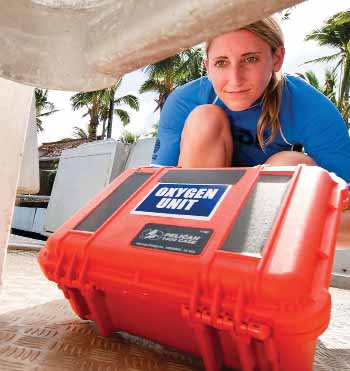
Plans should be formalized, kept updated and reviewed with all staff and contractors. Keep records of such training. Be aware that at least one dive accident litigation was lost in recent years in part because an incomplete dive briefing was shown to be causative in the accident, and boat crew did not know where the emergency oxygen kit was located once otherwise effective emergency procedures were initiated. The victim died without receiving oxygen.
Emergency Equipment
All necessary emergency equipment should be on hand, familiar to the staff onsite and in good working order. Emergency oxygen should be considered standard, and oxygen cylinders should have adequate fills and proper delivery systems. While AEDs are not yet considered standard equipment in many areas (although they are required in some areas), of course, they can be helpful in some situations.
Conversely, emergency equipment on site but inoperable (such as lack of gas, missing parts, dead batteries) can prevent proper treatment of a victim and can become a severe detriment in litigation. Similar issues have directly attributed to several significant litigation pay-outs in recent years.
Insurance
Everyone involved in dive instruction and supervision should be properly insured – this means dive centers, dive boats, instructors and divemasters. Make sure that dive professionals have associated dive centers and boats named as additional insureds on professional liability policies. For PADI Members who have PADI-endorsed insurance, the dive centers you work for are automatically additional insureds. When the store has the PADI-endorsed group pro policy through which all pros associated with the store are insured, the store is covered for their activities.
It’s also a good idea to make sure any dive boats you use have current insurance. In the case of an accident, there can be serious disadvantages when one of the parties in a lawsuit does not have insurance. This increases the risk that the uninsured party may decide to cooperate with the plaintiff s to protect itself from financial ruin. It could also effectively block a negotiated settlement because the uninsured party can’t afford to participate.
Third-party Partners and Service Providers
If you don’t own a dive boat, pool or a dive site, you need to involve third parties who do. When involving third parties, it’s wise to meet with them, learn about their qualifications, supervisory and look-out techniques, emergency equipment and victim egress procedures, and find out whether they are insured.
Their effectiveness when an emergency occurs may prevent a developing incident from becoming a serious accident. It may prevent an accident from becoming a serious injury or fatality. Conversely, inattention or lack of proper equipment, staffing or training, can turn a routine diver assistance into a significant accident.
Unfortunately, untrained or inattentive dive boat crews along with inadequate
equipment and procedures have been a significant cause of dive fatality litigation losses in which a dive instructor and dive center were also named.
“When involving third parties, it’s wise to meet with them, learn about their qualifications, supervisory and look-out techniques, emergency equipment and victim egress procedures, and find out whether they are insured.”
Dive emergency preparedness, especially when formalized and practiced, can be a crucial element in preventing accidents and showing response readiness, and can be a powerful defense tool in litigation as documentation of professionalism. Conversely, the proven lack thereof can be an equally significant detriment to even the most well-intentioned dive professional or business.
This article originally appeared in the 3rd Quarter 2019 The Undersea Journal.