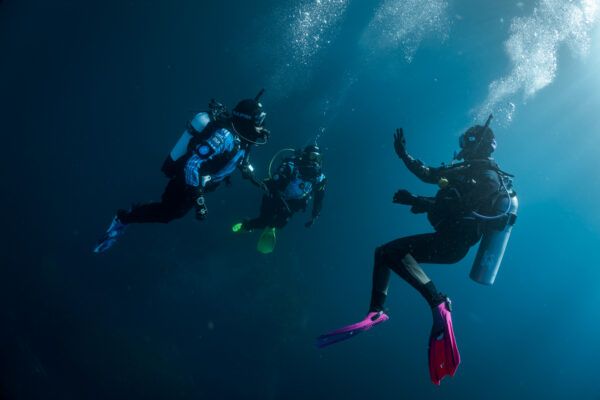
The Controlled Emergency Swimming Ascent (CESA) is one of the most complex skills in the Open Water Diver course. It’s also an important emergency procedure to learn. After successfully completing the skill in confined water, applying it in open water instills confidence in novice divers that in the unlikely situation in which an alternate or redundant air isn’t available in an emergency, there is another option.
Organizing the skill so students fulfill the requirements in open water takes logistical preparation. Here’s clarification of some key points to help you set this skill up for success.
The requirements in the Open Water Diver Course Instructor Guide from the PADI® Instructor Manual state:
Setting up the Exercise
Use a vertical control line buoyed by a surface float. Ensure that the line is either tied off firmly at the bottom or held down with sufficient weight to enable you to stop the ascent at any time by grasping it with a hand or leg wrap while holding the student firmly. Conduct the skill one student at a time while maintaining physical contact with both the student and the control line.
The intent of using a secured vertical line is to provide you with as much control as possible in terms of ascent rate, stopping or slowing the ascent, and monitoring the student’s exhalation while looking for signs of stress. For proper control, you must grasp both the student and the control line. Either hold the line with your hand or use the leg wrap technique to maintain contact with the line.
Holding the Student
A common, effective technique is to firmly grasp the student’s BCD at a point where you can position yourself slightly higher than the student. This allows you to easily see the student’s face looking up toward you, and hear and see continual exhalation. Remember not to hold your own breath while watching and listening for your student’s continual exhalation as you both ascend.

Holding the Line
Effective control means you can immediately stop or slow the diver’s ascent. This can only be done if the line is thick enough and is secured both at the bottom and surface.
- Line thickness
- The diameter must be large enough (at least 12 millimetres/½ inch) to allow you to easily wrap your leg or hand around it, pull it taut, and stop you and the diver from further ascent. A thin line, such as a reel line, does not provide enough stability or adequate support to reliably stop an ascent.
- Line secured
- At the surface. The line must be secure at the surface. If secured to a float, ensure that the float is big enough so it doesn’t submerge when you pull on the line. It must have enough buoyancy to remain on the surface with two divers (you and the student) on the line. Surface marker buoys or small floats that easily submerge do not provide enough positive buoyancy for this skill. Keep in mind that the float also serves as a buoyant surface support at the end of the skill once the student reaches the surface.

-
- At the bottom. The line must also be secured on the bottom. It must not pull free when used to halt two divers’ ascent. Secure the line using something that will hold the line firmly on the bottom (such as an anchor); or to a bottom attachment, such as a mooring pin. The bottom composition and location will dictate what is most appropriate. You know that securing a line to coral or other living bottom material is inappropriate.

When set up in this manner, the CESA line can also be used as a descent/ascent line during training, and provide a secured reference to conduct other skills during the Open Water Diver course.
For additional tips and techniques, review the Open Water Diver Course Conduct and Skill Recommendations in PADI’s Guide to Teaching.
This originally appeared in the 2nd Quarter 2019 Training Bulletin. You can read a PDF of the full edition here.