As part of an ongoing commitment to cutting-edge education for divers and dive professionals, the PADI® Instructor Development Course (IDC) was recently updated. The revised program has an increased focus on interactive workshops, allowing Course Directors and IDC Staff Instructors to play a greater role as advisors and mentors.
Reduced Lecture, Increased Interactivity
To free up valuable in-person time, candidates develop their foundational knowledge primarily via independent study (PADI eLearning®). Learn more about the completely updated online program in our companion article about the updated IDC eLearning and all-digital IDC Crew-Pak.
The revised IDC is not a radical departure from the established program that has given thousands of divers the confidence and skills to become successful dive instructors. Instead, the updated program takes a more interactive approach to training. Rather than listening to a lecture about how to teach, candidates learn how to think like an experienced instructor by working through real-world teaching scenarios with their Course Director(s) and IDC Staff Instructors providing prescriptive guidance.
In this article, Course Directors who field trialed the revised IDC share their opinions and insights on many of the new workshops. For a thorough overview of the updated program, review the 4th Quarter Training Bulletin (visit the PADI Pros’ Site and click on Training Essentials), or read a summary of the key changes on the PADI Pros blog.
I have now run three “new’ IDCs in three different countries (UK, Egypt and Carriacou in the Caribbean). All IDC groups were much more engaged as they had to actively participate throughout workshops. I feel they have grasped the concept of thinking like an instructor much earlier on in the process, which is going to be key to them being competent and confident instructors.
– Kerrie Eade, PADI Platinum Course Director Ocean Turtle Diving and ProDive UKOne huge advantage of the revised IDC is that it allows us to create instructors who are more prepared to teach. We give candidates more inwater practical experience and there’s an increased focus on realistic training scenarios. The updated content is fantastic and the structure of the course is more candidate-focused and also more comprehensive. The most frequent feedback I received from candidates was they could not believe how much we had done and what they had learned.
– Holly Macleod, PADI Platinum Course Director Trawangan Dive, IndonesiaOverall, I really loved teaching the revised PADI IDC course. There were a lot of real-life workshops that made candidates prepare more realistically for teaching than the previous IDC. The workshops also brought candidates closer together and most importantly made them feel like teachers throughout the IDC instead of just participating in a course or being evaluated.
– Marcel van den Berg, PADI Platinum Course Director Sairee Cottage Diving, Koh Tao, Thailand
New Workshops Prepare Candidates to Think Like an Instructor
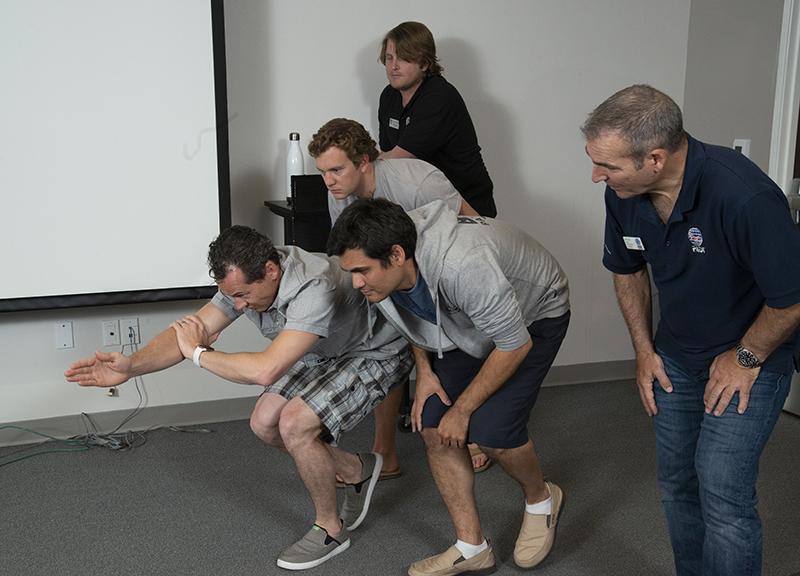
The new IDC curriculum uses a scenario-based approach that emphasizes development, not testing. Candidates work through real-world teaching scenarios with their Course Director(s) and IDC Staff Instructors guiding them through the decision-making process. During these workshops, candidates learn how to think like an experienced instructor.
I have to admit, giving up some live presentations to make time for workshops was one of the hardest things for me to do in this revised IDC. So I was extremely pleased how well the workshops worked. They gave candidates a genuine appreciation for how to “think like an instructor.’ It felt real-life, it was great for team building and amazing practice for the standards exam. I did add some personal (CD) tips from experience in live presentations later on in the IDC.
– Marcel van den Berg (Sairee Cottage Diving Koh Tao, Thailand)
Platinum Course Directors Nico Bergere (All 4 Diving, Phuket, Thailand) Holly Macleod (Trawangan Dive, Indonesia) and Marcel van den Berg (Sairee Cottage Diving Koh Tao, Thailand) share their thoughts on specific workshops:
Open Water Training (Nico Bergere) Getting students to think about how to plan different training dives in different dive environments with all the other things they have to think about is a good approach to prepare then to teach around the world. The dry presentation for open water training was very helpful. We set up the classroom with lines, lift bag, fake rock and coral. It was great fun!
Open Water Course Scheduling (Nico Bergere) Another very good workshop. It helps students realize that teaching diving requires a lot more preparation and organization than they thought.
Learning and Teaching (Nico Bergere) My favorite of all was the Learning and Teaching Workshop. It’s important for an instructor to be a good educator, but it’s just as important to be a good public speaker, able to handle students’ mood and behavior during the course, all while staying within standards and applying good judgement. Employers appreciate an instructor who can provide great customer service. I believe that this workshop is straight on that point. My students had a very good time going through the different scenarios.
Dive Theory Workshop (Marcel van den Berg) The candidates completed Dive Theory eLearning and the Diving Knowledge Workbook before the start of the Dive Theory presentations and workshop – which we conducted over two days. On the first afternoon, I gave a live physics and physiology presentation because one candidate didn’t have a lot of time to prepare and was worried about physics.
On the second day, we did the new Dive Theory Workshop and I used the new Course Director Manual curriculum. Candidates took turns explaining and teaching different Dive Theory questions from the Diving Knowledge Workbook to each other. This was great and good for team building, especially in the beginning of the IDC.
Risk Management and Licensing Workshop (Marcel van den Berg) Risk management has always been a personal baby of mine as I have seen differences in safety attitudes among other professionals. I made it my personal mission as a Course Director to try and teach the best Risk Management Workshop for my IDC candidates, because knowledge and attitude comes from the top.I focus mainly on different real-life accidents that arise from the most common “bad’ behaviors of divemasters and instructors; however, I often run out of time covering all the different scenarios. I was, therefore, very pleased to see the new IDC eLearning presentations focusing so much on risk management. I still ran a bit out of time doing both, but I learned a lot and already know how to manage time better for the next IDC.
Advanced Open Water Diver Workshop (Holly Macleod) The workshop was awesome and a massive learning benefit for the candidates. They practiced different control techniques for deep dives, assessment in shallow water, and supervision through the dive. It was also a great opportunity to use different dive sites beyond our standard training location, more interesting, varied conditions, and a lot of fun for the candidates.
Rescue Workshop (Holly Macleod) We made this into an entire day with a confined refresher session in the morning to review techniques before the open water workshop in the afternoon. It was great fun, incredibly valuable practice and it led to awesome results during the rescue teaching presentations the following day.
The Revised PADI IDC Course – Key Differences
- Increased focus on interactivity including new workshops (described above)
- Candidates complete two additional rescue scenarios:
- Rescuing a panicked diver at the surface.
- Removing an unresponsive diver from the water and administering emergency oxygen using a rescue breathing mask.
- A new emphasis on perseverance – telling students they have not learned something yet positions mistakes as a positive part of the learning process.
- Candidates learn how to use PADI Digital Products and online tools such as the PADI Online Processing Center (OLPC).
- The minimum number of required days has increased by one day
- If candidates complete IDC eLearning, the minimum number of days is six.
- If foundational curriculum is delivered by live presentation, the minimum number of days is eight.
- If candidates complete IDC eLearning, the minimum number of days is six.
- Candidates complete the majority of their knowledge development via PADI eLearning prior to the in-person part of the course.
- The revised program includes new teaching presentation scenarios and dry skill practice.
The enhanced range of scenarios for teaching presentations gets candidates away from a formulaic approach to presentations. Each presentation differs considerably both in terms of staff and student level/supervision. It really made candidates think about how they would manage skills practice and gave them far more realistic situations to consider and plan for [including] a greater focus on con-ed skills in open water and teaching with and without a certified assistant in confined and open water.
– Holly Macleod (Trawangan Dive, Indonesia)
Learn More or Prepare to Teach the Revised IDC
Review the 4th Quarter Training Bulletin for more information including:
- A complete list of standard changes and updated products
- A detailed explanation of curriculum enhancements
- Revisions to PADI’s Guide to Teaching
CD and IDC Staff Instructor Updates – attend an in-person update before teaching the new course. All CDs and IDC Staff must complete their updates prior to December 2020.