Manta season in North Male’ Atoll Maldives
Every year by late June and towards the end of November a spectacular show starts on the house reef at Paradise Island Resort (manta rays Manta Birostris). First in small numbers and then more and more until the mantas form huge groups. Manta rays may reach a width up to 670 cm and there have been reported sightings of 910 cm width; specimens of 400 cm disc width or more are common. They are harmless as they have no sting or venomous spine. Manta Point Lankan is 10 minutes by boat and the site is on the house reef.

Cleaning stations of dive site Lankan Manta Point
Manta rays feed on plankton (plankton is made up of microscopic plants and animals). It is amazing that something that gets so big in size feeds on the smallest micro animals that live in the ocean. The planktonic organisms are ingested through the rays wide open mouth and sieved through the gills. The gills are designed as complex filtering plates.

Breach out of the water
Manta rays are capable of rapid speeds and will sometimes leap high out of the water, landing with a loud slap. Where manta rays gather there is a possibility that you might see a mating dance – several males chasing a single female, each displaying its own acrobatic skills, competing with each other for the female. Females can sometimes be seen with a swollen tummy indicating pregnancy. The rays are often seen in shallow water whilst feeding on the surface.
Have a look at this breach by a manta captured from underwater and from the surface from Sun Island Resort & Spa
Manta season for South Ari Atoll in the Maldives is from late November until late April. Visit Holiday Island or Sun Island to dive or snorkel with Manta Rays. Below is a link from DiveOceanus youtube channel of one of the best captured clips both underwater and also from the surface.
[youtube https://www.youtube.com/watch?v=FBDURrd3M3w]
Feeding and grooming
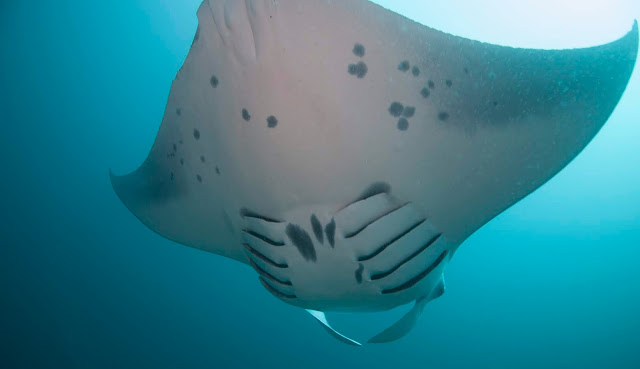
The real reason for the rays gathering around the big coral heads is that when they are traveling from atoll to atoll (the manta ray is a pelagic ocean traveler), following their food source, tiny white parasites start to feed on the skin of the rays. The big corals where the rays gather is actually a “cleaning station” – the home for a number of fish that feed on parasites living on other marine life. These are wrasse (Labridae) – the Blunthead Wrasse (Thalassoma Amblycephalum) and the Cleaner Wrasse (Labroides Dimidiatus). The rays hover above the coral heads waiting to be cleaned by the wrasses. Once they have been cleaned they glide back to the ocean leaving space for another to be groomed and so the cycle continues for a long time.
When and where to visit
During the plankton season, late June until late November, manta rays can be found in many sites around North Male’ Atoll. Some of the most popular dive sites for mantas are Lankan (Paradise Island house reef ), Furana Thila (a small channel 15 minutes boat ride from Paradise Island) and Sunlight Thila (15 minutes boat ride from Paradise Island). Visibility during these months is normally about 10 metres or better. At all three dive sites, mantas are active and very close, or on top of cleaning stations suggesting that the grooming is a must during the manta season in North Male’ Atoll. Divers should stay well away within a boundary explained by the dive guides during briefings. It’s a must that no one should touch the coral or be right on top of the cleaning stations.

Help identify manta rays
Very little is known about how the rays travel from atoll to atoll, whether they use the same route every year or how far they travel. However, some rays have been seen returning to the same dive sites year after year. Every manta ray has a different marking on the belly. These black patches can be used to identify different individuals. You can submit photo’s shots of manta rays seeing during your dives in the Maldives to Manta Trust a friendlier practice then tagging manta rays.
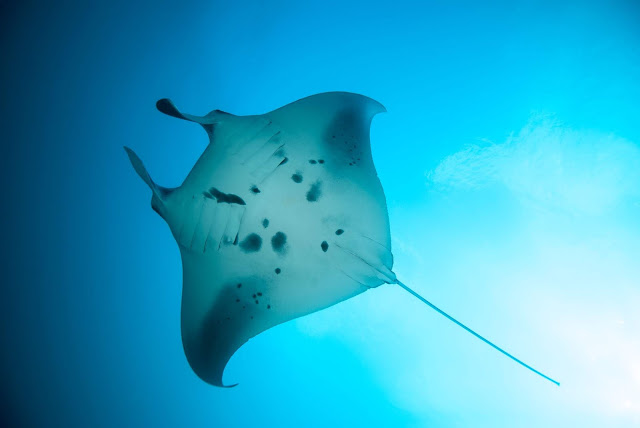
Every manta has a different set of patches that are unique to each individual.
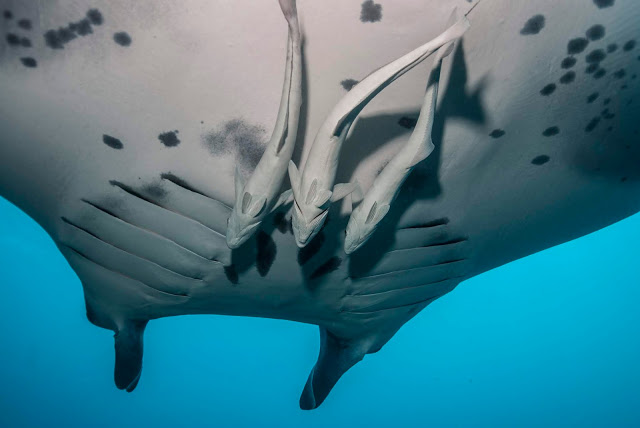
The two most common breeds of rays known to be found in Maldivian waters are:
MANTA RAY ( MANTA BIROSTRIS) PYGMY DEVILRAY ( MOBULA EREGOODOOTENKEE )The name for manta ray in Dhivehi is Enn Madi
PADI’s guest blogger Mohamed Seeneen introduces himself:
 Seeneen (Sindi) started out his dive career as a PADI Divemaster 22 years ago in the Maldives after a period of two years his reached up to his PADI Instructor status. His passion for environment and photography started at the early stages of his open water course. Images were the only way of showing or expressing what he felt. He got his break in October 2009 when he was selected as the official photographer of the World’s 1st Under Water Cabinet Dive in The Maldives. A founding member of the Divers Association Maldives today he works with a proud team of some 30 dive professionals at five different dive centres known in the Maldives as DiveOceanus a brand that has been Winner at SATA South Asia’s Leading Dive Centre for the last three consecutive years.